If a retailer has brought up Sunrise 2027, or you’ve seen it on a supplier checklist, here’s what it means for your products, whether it’s a deadline you have to hit, and the measured way to get ahead of it. The short version: retail is moving from the 1D UPC barcode to 2D barcodes (like QR codes) by the end of 2027, you keep your UPC during the switch, and adding a 2D barcode now gives you marketing and analytics you don’t have today. No panic required. Here’s the detail.
What is Sunrise 2027?
Sunrise 2027 is GS1’s target for retailers to be able to scan 2D barcodes at checkout by the end of 2027. Today, almost every product at retail rings up with a 1D UPC barcode, the striped code that’s been on packaging for 50 years. Sunrise 2027 is the industry’s agreement to upgrade checkout systems so they can also read 2D barcodes: QR codes that carry your product’s GTIN, usually through the GS1 Digital Link standard.
The name is the point. It’s a sunrise, not a shutoff. Retailers are agreeing to be able to accept 2D barcodes by the end of 2027, the same way a sunrise arrives gradually, not a switch that flips off your old barcode overnight.
Is Sunrise 2027 a hard deadline? Do I have to do something by 2027?
No, not in the “or else” sense. Sunrise 2027 is a rolling “can accept,” not a “must switch.” Your UPC barcode keeps working at checkout, and nobody is going to fine you or pull your product in 2027 for not having a 2D barcode yet.
During the transition, products carry both codes. The industry calls it dual marking: you keep your UPC and add a 2D barcode next to it. GS1’s own guidance says items will need both through the changeover, so your existing barcode isn’t going anywhere soon.
So the honest answer is: you don’t have to do anything by 2027 to keep selling. But there are good reasons to start now, which is the rest of this guide.
Why is retail moving to 2D barcodes?
Because a 1D barcode can only hold one thing: your GTIN. A 2D barcode holds far more. It can carry the GTIN plus a batch or lot number, an expiry date, or a serial number, and it can point to a web page at the same time. That extra data is what retail wants.
For retailers and brands, that unlocks a few things a plain UPC never could:
- Freshness and food safety. An expiry date in the code lets a store pull or discount items automatically, and cut waste.
- Traceability and recalls. A batch or lot number makes it possible to recall exactly the affected run, not an entire product line.
- Authentication. A unique code per item is far harder to counterfeit than a shared UPC.
- A direct line to the shopper. The same code opens a web page, so your packaging becomes a channel you can use and measure.
That last point is where the GS1 Digital Link standard comes in, and it’s worth understanding before you print anything. We cover it in depth in our guide to GS1 Digital Link QR codes.
2D barcode, QR code, GS1 Digital Link: what’s the difference?
These three terms get used interchangeably, so here’s the quick version. A 2D barcode is the category, any code that stores data in two dimensions. A QR code is the most common type of 2D barcode. GS1 Digital Link is the standard that puts your product’s GTIN inside the QR code’s web address, so a scanner reads it as your product and a phone opens it as a page. When people talk about the 2D barcode on your pack for Sunrise 2027, they almost always mean a GS1 Digital Link QR code.
What does Sunrise 2027 mean for my packaging?
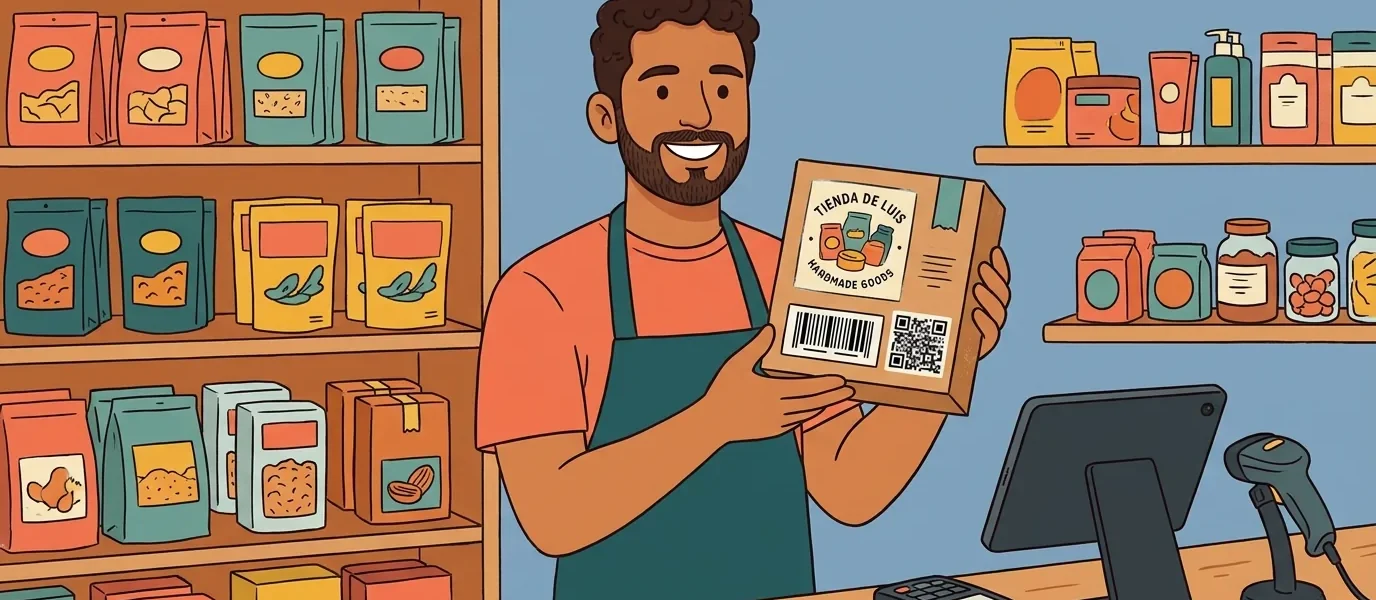
In practice, one change: you dual-mark. Keep the UPC barcode you already print, and add a GS1 Digital Link QR code next to it.
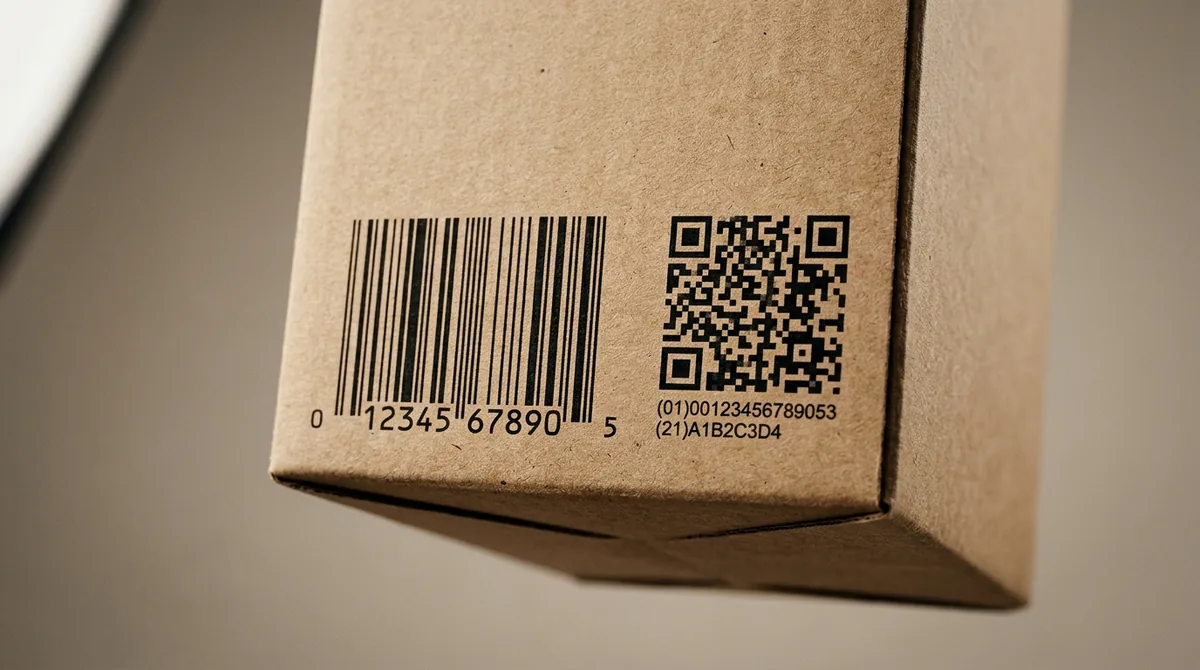
Two things are worth being clear about. First, you control your side, which is adding the QR code to your artwork. Whether that code actually scans at a given store’s register depends on that retailer’s checkout systems and their item file, which is their side and GS1’s, not something you or we control. Second, you bring your own GTIN. You license it from GS1; we don’t issue GTINs, we build the GS1 Digital Link QR code and the resolver around the number you already own.
What happens if I do nothing?
Nothing breaks in 2027. Your UPC keeps scanning, and you can keep selling exactly as you do today. The cost of waiting isn’t a penalty, it’s the upside you leave on the table.
A plain UPC gives you no idea who scanned it, from where, or when, because it was never meant to. Add a GS1 Digital Link QR code and you get analytics on every scan, a destination you can point at a promotion, a recipe, or a recall, and richer data for the retailers asking about 2D. Do nothing and you keep none of that, and you’ll be retrofitting your whole catalog later, under a retailer’s timeline instead of your own.
How do I get ahead of Sunrise 2027?
Add a GS1 Digital Link QR code alongside your barcode now. It gets your packaging ready for 2D retail, and it works as a marketing and analytics channel from the day it ships, not in 2027.
That’s what our connected packaging is built for. You bring your GTIN; we handle the GS1-conformant resolution, the destinations you can change at any time, and the scan analytics. If you want the full picture of how the QR code itself works first, start with our guide to GS1 Digital Link QR codes.
Frequently Asked Questions
Is Sunrise 2027 mandatory?
No. Sunrise 2027 is GS1’s target for retailers to be able to scan 2D barcodes by the end of 2027. It’s a rolling industry transition, not a law or a fine. Your UPC barcode keeps working, and you can adopt 2D barcodes on your own timeline.
Do I have to remove my UPC barcode?
No. During the transition you keep your UPC and add a 2D barcode next to it, which is called dual marking. Your UPC keeps scanning at checkout exactly as it does today.
Will my product stop scanning in 2027?
No. Sunrise 2027 is about retailers being able to also accept 2D barcodes. It does not turn off UPC barcodes, so your product keeps ringing up at the register.
What’s the difference between Sunrise 2027 and GS1 Digital Link?
Sunrise 2027 is the retail industry’s timeline for accepting 2D barcodes at checkout. GS1 Digital Link is the standard that most of those 2D barcodes use, the one that puts your GTIN into a QR code’s web address. Sunrise 2027 is the “when,” GS1 Digital Link is the “how.”
How do I add a 2D barcode to my product?
You add a GS1 Digital Link QR code next to your existing barcode. Bring the GTIN you license from GS1, map what the QR code should open, and export a print-ready code for your packaging. Our connected packaging handles the standards side so you don’t have to run a resolver yourself.
Can a 2D barcode scanner read 1D barcodes?
Yes. Modern 2D scanners are camera- or imager-based, and they read both 1D and 2D barcodes. That is part of why the shift to 2D is gradual: as retailers add 2D-capable scanners, those scanners still read every 1D UPC. An older 1D-only laser scanner, however, cannot read a 2D code.
How much data can a 2D barcode hold?
Far more than a 1D barcode. A UPC holds about 12 digits, which is just the GTIN. A QR code can hold up to roughly 7,000 digits or 4,000 alphanumeric characters at its largest size, which is enough room for the GTIN plus a batch or lot number, an expiry date, a serial number, and a web address.
What is a GS1 QR code?
A GS1 QR code is a QR code whose contents follow a GS1 standard, usually GS1 Digital Link, built around your product’s GTIN and resolved through a GS1-aware service. It looks like any QR code, but it carries machine-readable product identity, not just a link. People often use GS1 QR code and GS1 Digital Link QR code to mean the same thing.